
The Qur’ân and Sunnah speak frequently and emphatically about the fact that a worshipper who repents and asks forgiveness for his sins will be forgiven and will not be asked about those sins again. Ifact, Allah tells us that those sins will be exchanged for good deeds. Allah says: "Except those who repent and believe and work righteous deeds, for them Allah will change their evil deeds to good deeds, and Allah is Oft-Forgiving, Most Merciful." [Sûrah al-Furqân: 70] Ibn Kathîr discusses the issue ... [Continue Reading]
Human Beings Have a Great Capacity for Self-Delusion

There are two things one should be take heed of if one wishes to attain success and felicity: 1) To know the details of the means of attaining good and evil, and to beclear about these through witnessing them in the world around, through one'sown experience and that of others, as well as through reports one has heardabout earlier and latter nations. One of the most effective means for attaining this is pondering over the Qur'an, for along with the Sunnah, it clearly explains the paths to good ... [Continue Reading]
Increasing One’s Faith

Faith is indeed a blessing from Allah and should not be taken for granted. Just as it may increase and become fuller and stronger, it may also weaken and become less and less until it is minimal or non-existent. Hence it becomes very important for a Muslim to take steps not only to preserve his faith but also to increase it. The uppermost branch of faith is the true, sincere, committed belief in Laa ilaaha illalaah Muhammad Rasoolulaah. Iman has over seventy branches. The lowest or most basic ... [Continue Reading]
A Word for Word Meaning of The Quran
This set places one or a couple of words of the 'ayah' in one line of a column and gives their meanings side by side in another column, taking care to see that the flow and intelligibility of the English meanings are not thereby lost. This method enables the reader to identify which English words or phrases represent the meaning of which words in the Arabic text. It has the additional advantage of keeping the meaning strictly to the wording of the text or importing in the meaning any word or ... [Continue Reading]
Commentary of Surat at-Tawba: Repentance
It is called Surat at-Tawba and is also called al-Fâdiha (the Disgracer) because it disclosed the secrets of the hypocrites. Written copies of the Qur'an and reciters omit the basmala at the beginning of this sura, but there is disagreement about the reason for that. 'Uthman ibn 'Affan said that its meanings aresimilar to those of Surat al-Anfal and they were called "the two consorts" in the time of the Messenger of Allah. That is why they are put together and included in the "Seven Long Ones". ... [Continue Reading]
The History of the Qur’anic Text
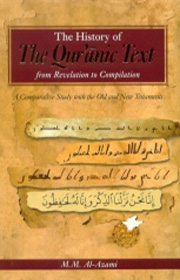
The History of the Qur'anic Text from Revelation to Compilation : A Comparative Study with the Old and New Testaments. The Qur'an reigns supreme in Muslim hearts as the most sacred of texts: a profusion of exalted ideas to rouse the mind, noble histories to stir the soul, universal truths to awaken the conscience and precise injunctions directing humanity to its own deliverance, all distilled into the melodious essence that is the Word of Allah. Through fourteen centuries Muslims have persevered ... [Continue Reading]