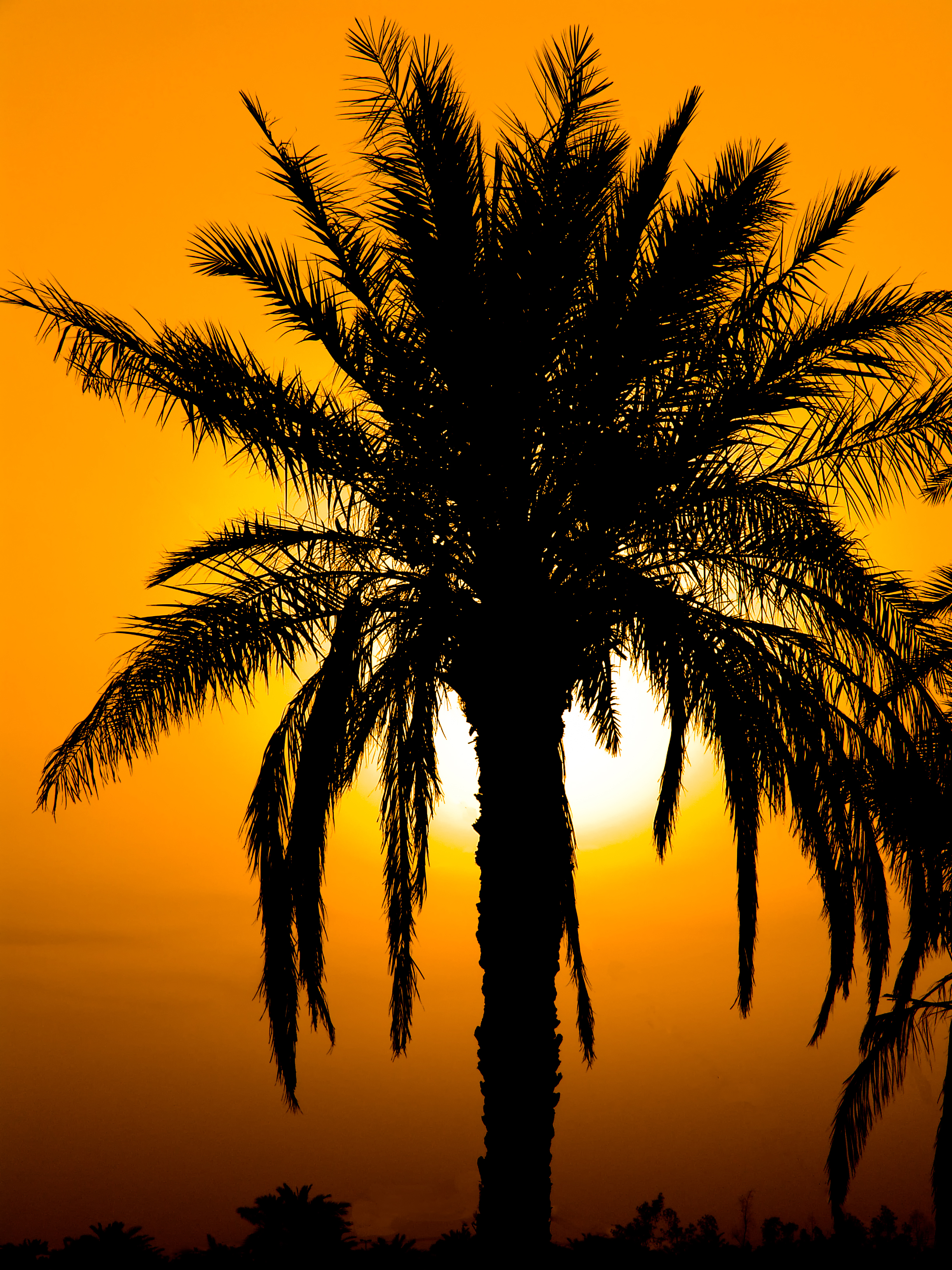
“And tall date-palms, with ranged clusters” (I)
- The decomposition of dead bodies in the grave, turning to dust except for part of the coccyx (the tail-bone at the base of the spine). The Prophet Muhammad (PBUH) and the fourth verse of Surah Qaf inform us of this; modern scientific research has confirmed the fact.
- The heavens are a unified structure, decorated with stars and there is no empty space that does not host some substance or energy because the heavens, as the verse states, have “no holes”.
- The earth is round in shape as it extends infinitely; such a characteristic is, ultimately, a sign of roundness.
- The creation of the mountains after the Earth to serve as pegs to balance the Earth during its orbit around the sun; they also serve as pegs to the Earth’s rocky surface so that it does not tremble.
- Everything that Allah (SWT) has created exists in pairs, making His oneness exclusive and manifest to His creation; scientific research has shown that all living beings exist in pairs.
- Allah (SWT) controls the water cycle around the earth with His knowledge, power and wisdom; rain, blessed, clean and pure falls from the sky by His leave. He allows it to fall to the ground reviving dead plants and allowing plants and grain to grow. Allah (SWT) compares the resurrection of man on the Day of Judgment with the germination of seeds after rain has fallen on them, further emphasizing the certainty and the importance of the resurrection.
- The description of palm trees as being tall with ranged clusters.
- Emphasis on the fact that humans are Allah (SWT)’s creation; He is the Creator of everything. Death is inevitable for all creation; that Allah (SWT) controls life and death and that He created life from nothing in the first place proves that Allah is more than able to resurrect His creation.
- Mention of the fact that the creation of the heavens and earth took place in six consecutive stages; a fact scientific research is currently addressing.
- The term “splitting asunder” to describe the opening of the earth to reveal those buried inside it.
“And tall date-palms, with ranged clusters” (I)
- Some of the obvious characteristics of palm trees are their stability in the ground, height, resistance to the wind, survival in extremely high, arid temperatures along with their durability, long life and abundant fruit production in spite of the harsh environment they live in. These trees also produce fruit that vary in shape, colour, taste, size and benefit in addition to all the benefits that can be extracted from each part of these blessed trees.
- Some of the hidden characteristics of palm trees lie in the amazing features that Allah blessed them with in order for to them to function effectively, from making maximum use of the water in the ground, channelling the desired compounds and nutrients into their roots and pumping sap to their upper parts, leaves, flowers and fruits, no matter how high these upper parts are and no matter how far apart the leaves, flowers and fruits are.
- Palmaceae is a family of about 200 genera of which, more than 40 species are trees, shrubs and climbers that are found mainly in tropical and temperate regions. Some of these species, like Phoenix dactylifera (date palm), are found in arid desert environments where the temperature sometimes exceeds 50°C and the ground-surface temperature is more than 90°C , in addition to there being scant rain. All of this shows the divine creation of palm trees, and in particular date-palm trees that derive maximum benefit from the slightest amount of water.
First: The root system
The root system of a date-palm tree starts to form as soon as the seed germinates. However, propagation can also occur through offshoots (offsets) or through tissue culture techniques. In all cases, the plant starts with the formation of the root system. The root system portion that comes out of the planted seed is called the primary root. Gradually, these roots start to disappear and are finally replaced by lateral roots arising from the stem of the seedling. As the plant grows, these lateral roots increase in size and number; these are fibrous roots that do not have any root hairs. The surface cells in these lateral roots absorb water and nutrients from the soil through epidermal cells. One special feature of palm trees is their amazing speed to form and spread their roots through the soil, especially sandy soil, in order to stabilize the tree and enable it to stand erect at great heights.
Second: The vegetative system
The palm tree trunk: the trunk is cylindrical in shape with a diameter ranging form 40cm to 90 cm; its height ranges from between less than two meters up to thirty meters or more. The trunk has no branches and is covered with a special type of fibre and with frond bases. These fibres and frond bases strengthen the trunk; protect it from environmental hazards and attacks by animals, water loss through evaporation as well as helping the trunk to stand erect tens of meters above the ground.The palm’s terminal bud: This contains the single special bud that exists at the top of the tree, where it stocks a big amount of the processed food sap. This special bud is responsible for the vertical growth process, which increases the height of the trunk and forms the leaves, flowers and fruits. The death of this terminal bud means the death of the tree; therefore, Allah surrounds it with a thick barrier cover consisting of the curled and clustered frond petioles in order to protect it from changes in weather conditions. The terminal bud of the palm tree is divided into a lower part, from which the fronds and fibre grow, and an upper part from which the clusters grow.The palm tree leaves (fronds): These are complex, very long, feather-shaped leaves. Their length ranges between three to six meters. Each palm tree produces between ten and twenty fronds every year starting with its terminal bud. The frond has a long, thick, strong but flexible midrib. The width of this midrib increases where it meets the trunk and decreases towards the midrib’s other end. Its colour varies from yellow to dark red to brown. It bears mini-leaves, which number ranges from 120 to 240 with length varies between 15cm to 100cm and which width varies between 1cm and 6cm. That is in addition to a number of thorns in the lower part of the frond. Each frond consists of a formed mini-leaf, which might exist solely or in groups. The mini-leaf connects to the central part of the leave through a swelling at the base of the palm leaf. Each leaf’s stem is surrounded by a sheath and produces a red fibrous substance, which surrounds the trunk, increases its’ thickness and strength, protects it and preserves the water inside it.
Third: the system of flowers and fruits in palm trees
Palm inflorescences emerge from auxiliary buds at the leaf base. The inflorescence is a complex spathe that branches into a few branches that bear flowers which either exist on top or are embedded in the branch that bears them.The spathe is a complex spikelet that includes the spadix and the flowers. The spadices are fleshy thick branches that bear the flowers. The unisex flowers (either males or females) are organized without a stem; meaning carried directly by the spadix. There are nearly ten thousand flowers in each inflorecences. This fact is reflected in the Qur’anic verse: “with ranged clusters” meaning organized clusters.